For sales-training firms with their own methodology

You can’t be in every session. Your method can be.

Between workshops, practice stops and the method fades. Sage gives your clients’ learners an AI customer built on your frameworks. It pushes back the way their real buyers do, and it scores every session on your rubric.

Sumanta Chakraborty

You’ll talk to me directly. I’ve spent close to thirty years leading teams across the US, Europe and Asia, and I’ve seen how much of a team’s performance comes down to conversations people never get to practice. Send me one framework from your method when you book, and you’ll watch it run on the call.Sumanta Chakraborty · Founder & CEO, nSpire AI

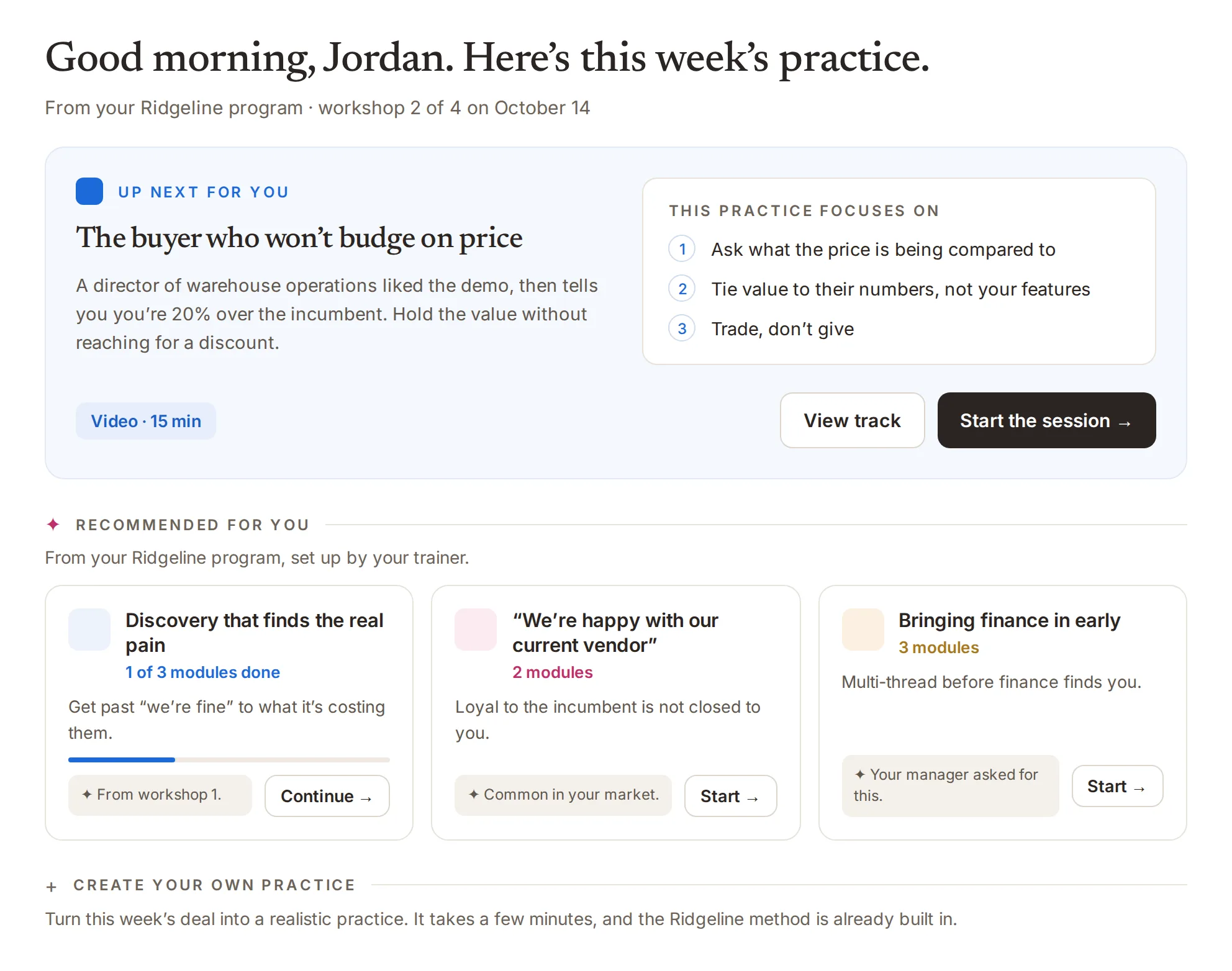
The Sage learner home: the next practice on the training firm’s method, the three steps it focuses on, and modules recommended between workshops.

Their practice week, on your method.

How they practice

Out loud, on voice or video.

Fifteen minutes against the customer they’re actually struggling with, on the weeks you’re not there.

After every session

A score on your rubric.

In your method’s language: what worked, what a real buyer would have punished, and what to work on next.

Setup

Live in 72 hours.

We build the first version from the decks, playbooks and rubrics you already have. You approve everything before a learner sees it.

Every engagement gets your method, or it gets your availability.

When a cohort grows or a second client signs, someone gets coached less. The method scales; the calendar doesn’t.

The workshop lands. Then the other fifty weeks happen.

Learners leave good and come back average, the forgetting curve at work. So far the answer has been a workbook and a follow-up email.

Your renewal is decided by what the client can point to.

Most sponsors can’t prove the training worked. The firm that can show who practiced, and which mistakes stopped recurring, wins that conversation.

LeeAundra Keany

In her words

“When I read the feedback that nSpire gives my students, it mirrors almost exactly what I would have given them — if I had the time to spend that quality one-on-one observation.”

LeeAundra Keany · Executive communications coach, 30 years · Faculty, UCLA Anderson School of Management

LeeAundra uses nSpire with her own coaching clients, took it into her classes at UCLA Anderson, and advises our team.

Anyone can build

It doesn’t depend on you or your facilitators.

Every learner can build practice for the deal in front of them, in minutes. You set the method once. They bring their own accounts, so the practice keeps happening between workshops.

From a document

An AE drops in the proposal for Thursday’s pricing call and practices holding the number.

From a template

A new rep takes your discovery module and adapts it to the buyer on tomorrow’s first call.

Talk it through with Sage

A CSM describes the customer threatening not to renew, and Sage builds the conversation.

Whatever they build still uses your methodology and the feedback template for that client’s program.

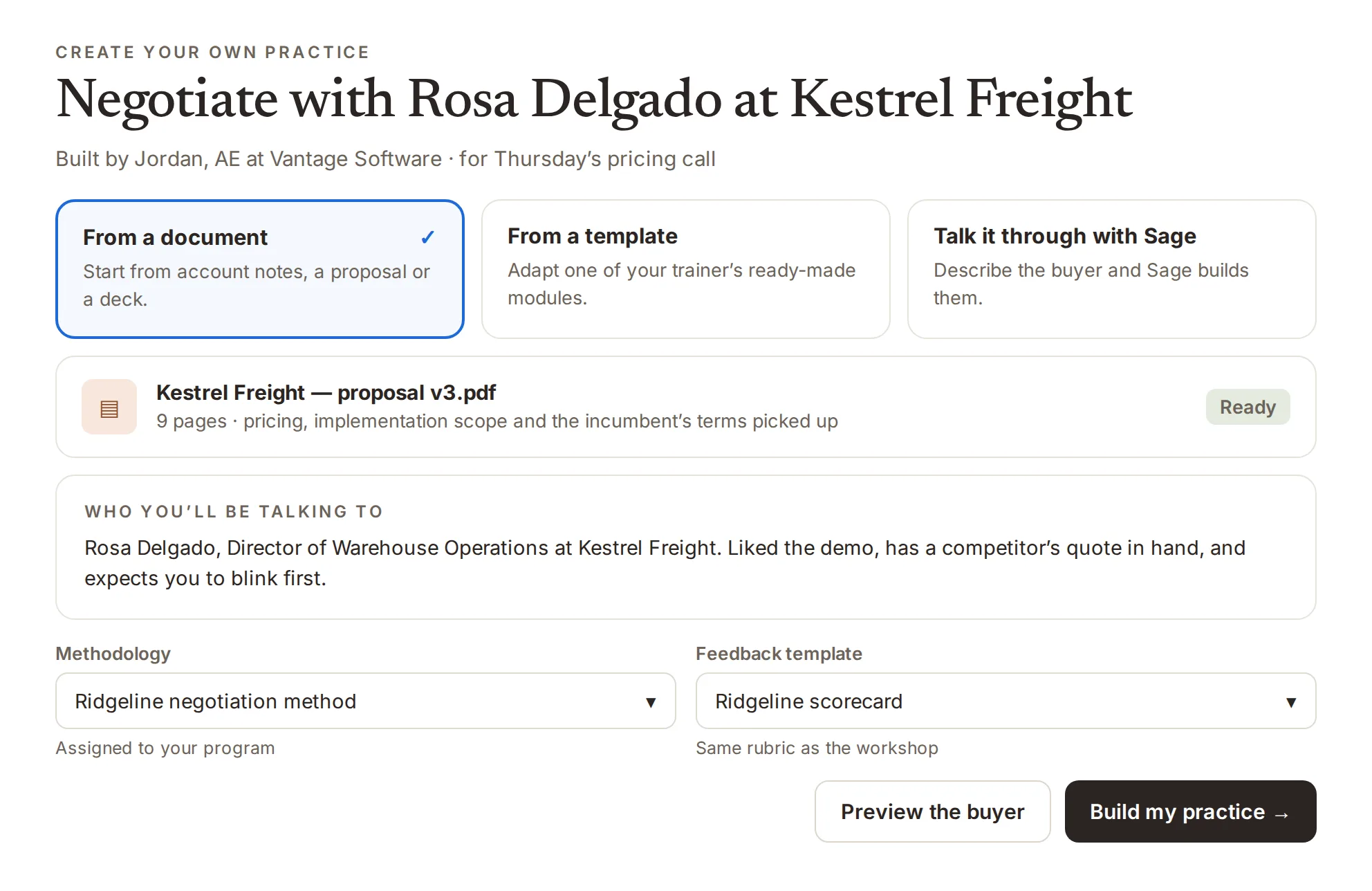
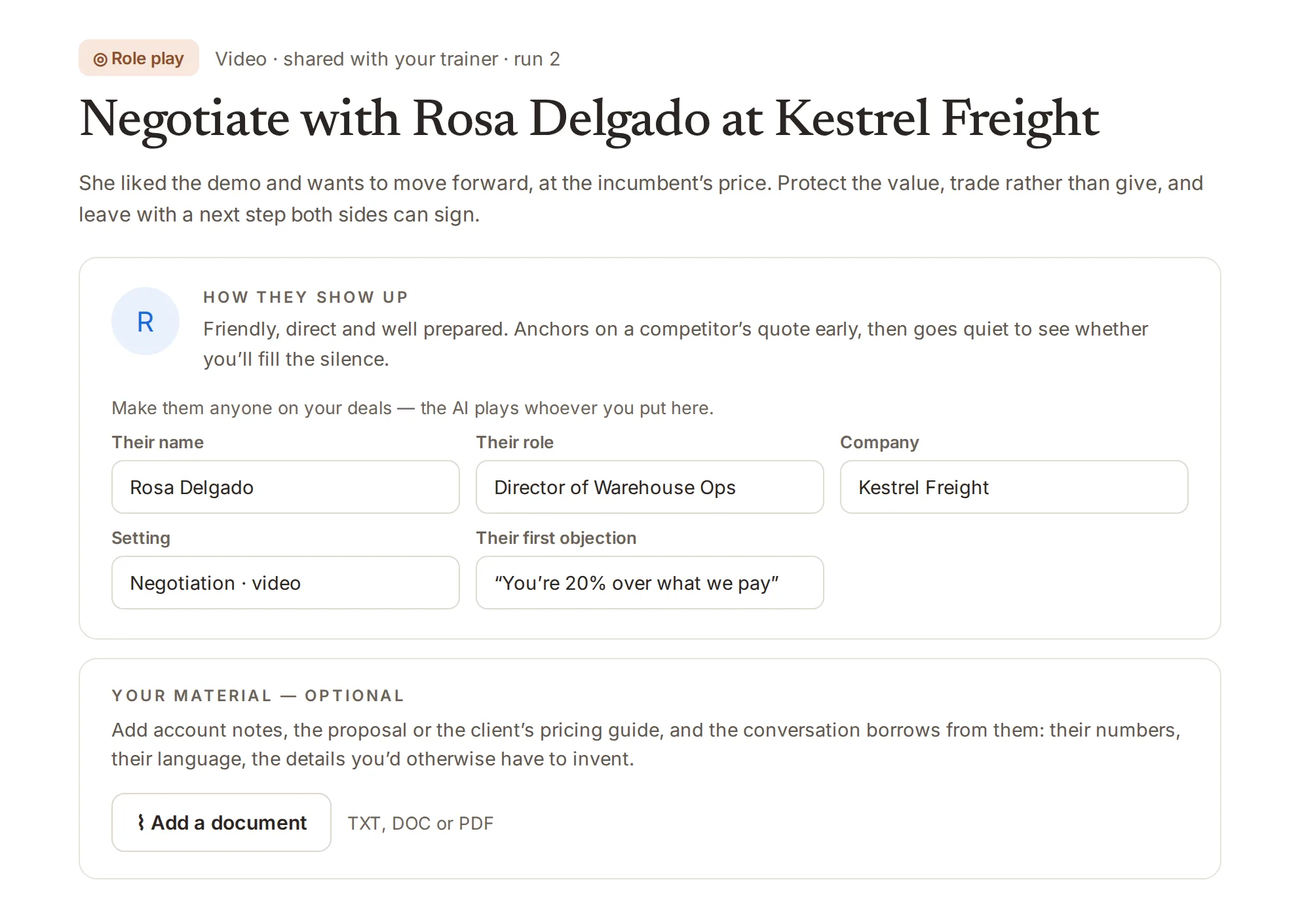
Create your own practice: an AE builds a pricing negotiation from the client’s proposal, with the training firm’s method and scorecard already assigned
A learner builds Thursday’s pricing call from the proposal.

Why I reached out

Sumanta Chakraborty

“After close to thirty years of leading teams, I’ve seen how much of a team’s performance rides on conversations nobody rehearses. I’m testing whether practice like this is useful for sales-training firms and the clients they serve. If it isn’t for you, tap . That helps me as much as a booked call.”

Sumanta Chakraborty · Founder & CEO, nSpire AI

Who built it

Built by people who’ve sat in the manager’s chair.

First-time manager, global team lead, VP, C-suite. Between us we’ve lived each step, and built nSpire around the conversations that come with them.

Sumanta Chakraborty

Sumanta Chakraborty

Founder & CEO

Close to three decades building products and leading teams across the US, Europe and Asia, at Siemens, Sony, LG, NVIDIA and Nuance. MBA, UCLA Anderson.

Bani Maiti

Bani Maiti

Co-founder & CTO

About thirty years leading global engineering teams, including as VP of Engineering at FireKing Security Group and in deep learning at Intel. M.Tech in Computer Science, Indian Statistical Institute.

Xiaohua Yang

Xiaohua Yang

Chief Customer Officer

Has led nSpire’s products and teams from first concept to multi-year enterprise contracts, and co-founded two companies before it. PhD, Cornell University.

Jennifer Ravalli

Jennifer Ravalli

Fractional Head of Growth

Former CMO of Harri, where she also ran sales, with leadership roles at ADP and iCIMS before that.

We’re also advised by LeeAundra Keany, executive communications coach and UCLA Anderson faculty.

How it works

One

You give it your method.

Your frameworks, your rubrics, your client’s context: their industry, their objections, the deals their reps actually lose. We build it with you, and nothing goes live until you’ve signed off. Learners can also build their own from a document, a template or a conversation with Sage.

Setting up a role-play: the buyer the learner will face, how she behaves, and her first objection.
Two

It becomes their customer.

The prospect who won’t budge on price, the buyer loyal to the incumbent, the stakeholder your client’s reps keep fumbling. Voice or video, fifteen minutes, any time between your sessions.

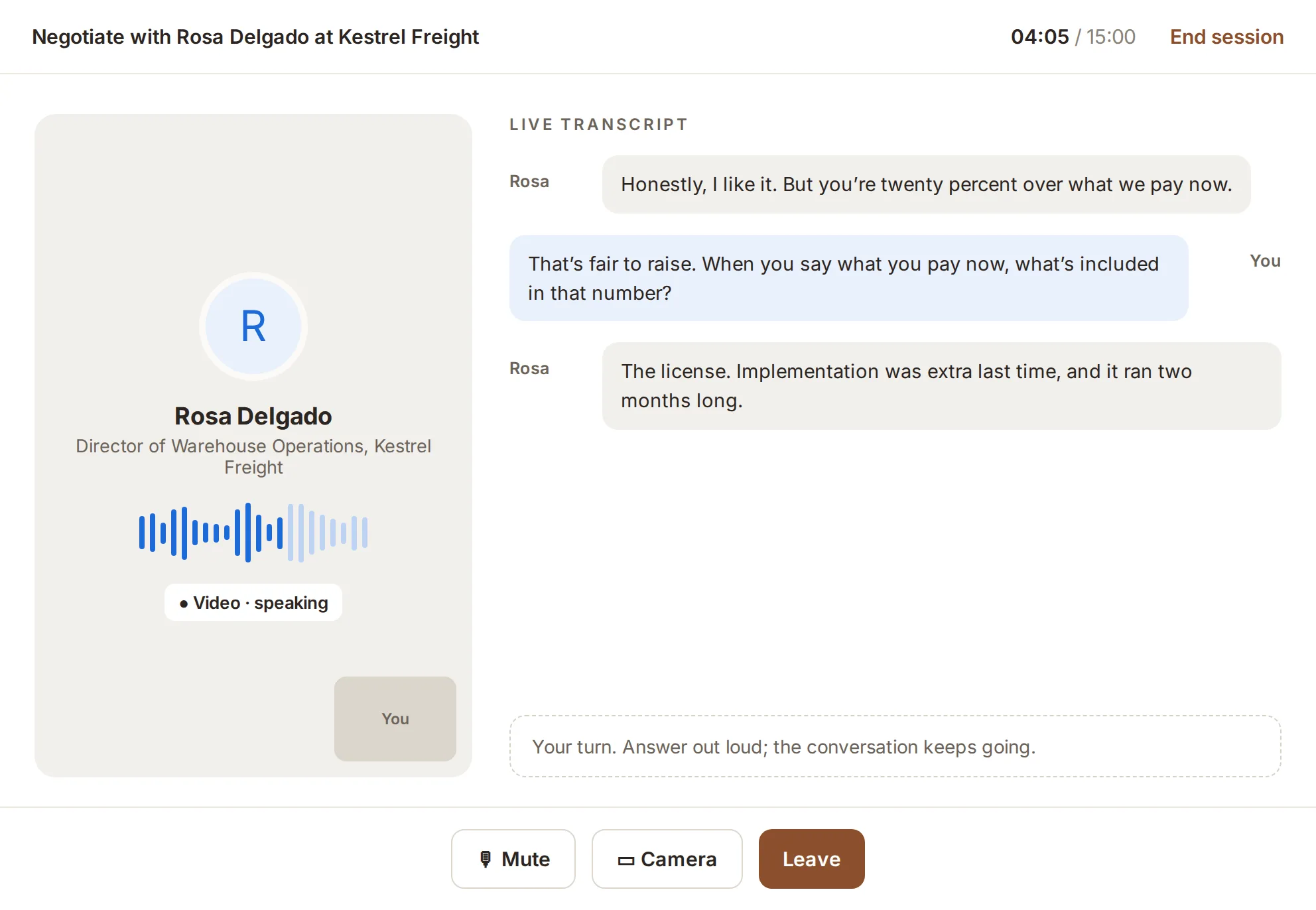
A live video role-play with the AI buyer, a live transcript and the session timer.
Three

You see what you’d otherwise miss.

Every session scored on your rubric. Who’s practicing, where the cohort is weak, whether the same mistake keeps recurring, all without watching a single recording. Your client’s sponsor sees a program that runs all year, not two days a quarter.

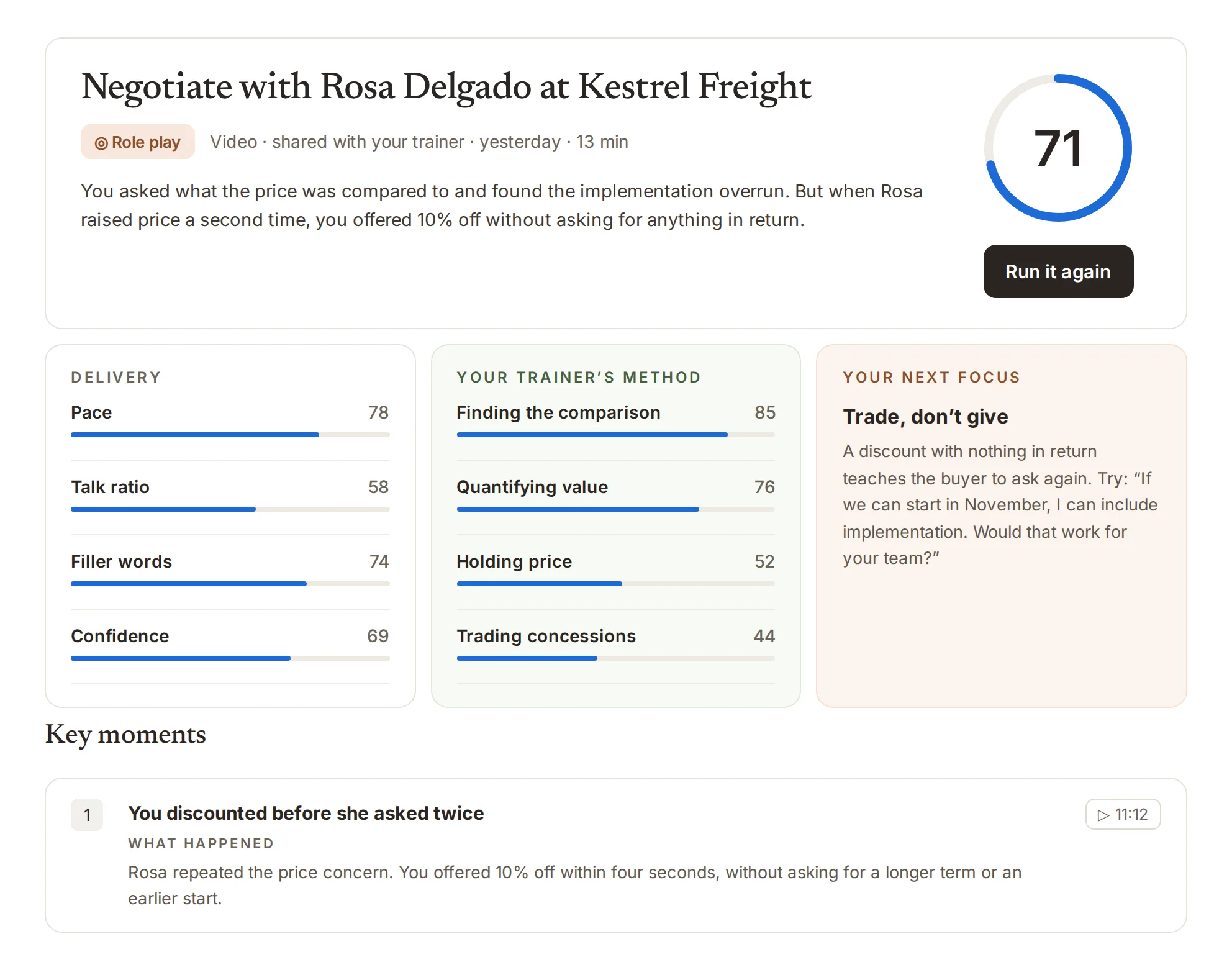
A scored feedback report: overall score, delivery and method breakdowns, the next focus and a key moment.

Early access

We’re looking for a small group of founding training partners.

Sales-training firms who want their method practiced between workshops, and want to help shape it while it’s early.

Your own workspace

Built on your methodology, ready for your first client program in 72 hours.

Founding pricing

Set with you on the call, built to fold into how you price engagements, and kept as you grow.

A direct line

To the people building it. What you ask for shapes what we build next.

What we ask in return: use it on at least one client program, and tell us honestly what works and what doesn’t.

Questions

The ones that come up on the call.

Who owns my methodology once it’s in nSpire?

You do, entirely. Your material is used only to build your scenarios and rubrics. It isn’t shared across accounts, other firms never see it, and nSpire doesn’t train its AI models on it. Your method is your business; treating it that way is a product decision, not a promise.

Does this replace my coaching?

No. It’s the practice learners do between your sessions, the part you were never going to be in the room for anyway. You still run the workshops, the live coaching, the relationship. Sage is your method holding the line in between.

How does it actually learn my method?

It doesn’t guess at it. We build your scenarios, personas and scoring rubrics with you from your existing material: workshop decks, playbooks, call frameworks. You review and approve everything before a learner sees it. First working version in 72 hours.

Can it reflect each client’s world, not just my method?

Yes. A track carries your methodology plus that client’s context: their industry, their competitors, the objections their reps hear. The same framework, practiced against a different customer for each engagement.

Can learners build their own scenarios?

Yes, three ways. Start from a document, like a proposal or account notes. Adapt one of your modules. Or describe the buyer to Sage and build it from scratch. Whatever they build still runs on your method and your rubric.

Can I control how feedback is given?

Yes. Each track and module can carry its own methodology and feedback template. If you want every learner on every client program scored on one rubric, that’s a setting, not a project.

My clients’ reps won’t want their fumbles watched.

Sessions are private by default, so a learner can get it wrong without an audience. What rolls up to you and the sponsor is practice and progress, not embarrassing recordings. That privacy is most of why reps come back a second time.

What happens when I add a facilitator?

Two things. Learners get the same method whether you or your facilitator ran the workshop, because the practice layer doesn’t drift. And you can put a new facilitator in front of the same scenarios before they ever deliver to a client, rehearsed and assessed to your standard, not just certified on paper.

How is this different from telling reps to role-play with ChatGPT?

ChatGPT will play a customer, but it stays agreeable, doesn’t know your frameworks, and scores nobody against your rubric. Your clients could do that today without you. This is your methodology doing the pushing back, which is the difference between a chat and a rehearsal, and the reason it’s yours to sell.

How do I price it into my engagements?

We’re setting pricing with a small group of founding training partners now. Most firms we talk to fold it into the client engagement: a reinforcement layer the client pays for as part of the program, not a software line on your own P&L. We’ll work through the model that fits how you price on the call.

Is it secure?

nSpire is SOC 2, ISO and GDPR compliant. Your material, scenarios, recordings and scores stay yours, with access limited to the people you grant it to.

How will I know it’s working?

Three signals show up before any pipeline number: who practices without being told, where the whole cohort is weak on the same thing, and whether the same mistake stops recurring. You’ll see all three within the first two weeks, and they’re the same three things your client’s sponsor wants to see.

Anything else, bring it to the call.

Fair enough. What’s closest?

Reason
When should I check back?