For leadership trainers and training firms

The workshop ends Friday. The hard conversation lands in three weeks.

Between your sessions, participants rehearse the exact conversations you train, out loud, with Sage playing the defensive direct report, the skeptical peer, the overdue underperformer. Every attempt is scored on your framework, with their own words quoted, so you see who can actually run the play before the real moment.

Sumanta Chakraborty

You’ll talk to me directly. I’ve spent close to thirty years leading teams across the US, Europe and Asia, and the conversations that mattered most were the ones I never got to rehearse. Send me one piece of your method when you book, and you’ll watch it run on the call.Sumanta Chakraborty · Founder & CEO, nSpire AI

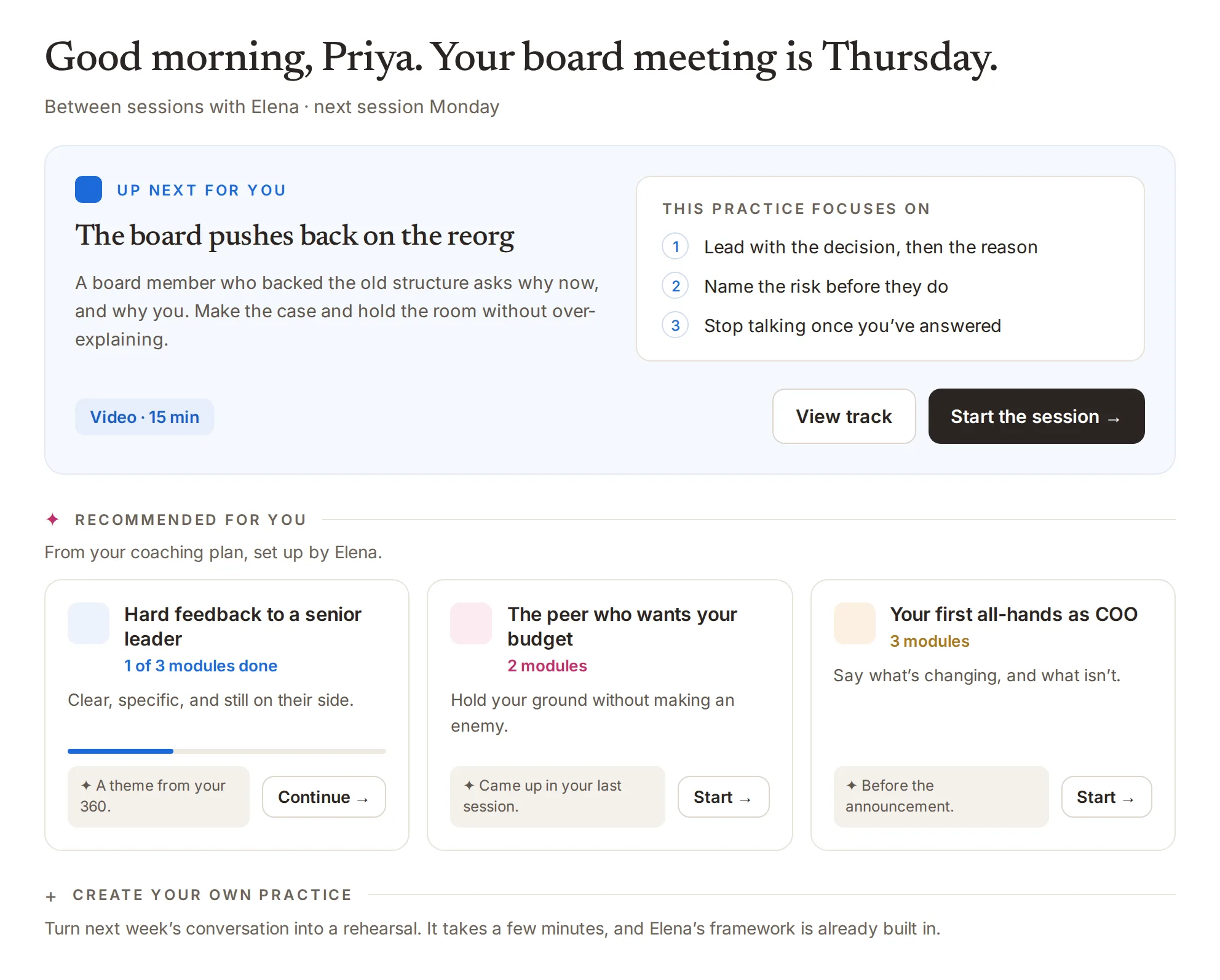
The Sage client home: the next practice on the coach’s framework, what it focuses on, and exercises recommended between coaching sessions.

Their practice week, on your method.

How they practice

Practice where the gap is.

Fifteen-minute reps on voice or video, assigned after each module, done from a browser. The learning happens where it was always lost: between the classroom and the real conversation.

After every session

An assessment layer, not a video library.

Assign a scenario after a module and see who can run the play. Every rubric point scored separately, with the participant’s words quoted as evidence.

Setup

Live in 72 hours.

Built from the frameworks, models and exercises you already use. You approve everything before a client sees it.

Tell and show scale in a classroom. Observe and feedback don’t.

A great facilitator can teach forty people a framework in a morning. Nobody can watch forty people try it. That’s why the skill decays before it’s used: no reps, no observation, no feedback. Sage gives every participant a practice partner and gives you the observation layer, with no facilitator hours added.

Your method scales. Your calendar doesn’t.

Every new client and every leadership-team engagement costs hours you don’t have. Sage carries your framework into the weeks between sessions, so your time goes to the coaching only you can do.

The L&D sponsor wants evidence.

Completion rates tell a sponsor people showed up. Rubric scores across attempts tell them who can now hold the conversation that used to end up in HR. When renewal time comes, you bring data instead of smile sheets.

Try a hard conversation yourself.

Three minutes out loud with an AI counterpart who pushes back, then a score on how you handled it. No sign-up.

Uses your microphone. About 3 minutes.

LeeAundra Keany

In her words

“When I read the feedback that nSpire gives my students, it mirrors almost exactly what I would have given them — if I had the time to spend that quality one-on-one observation.”

LeeAundra Keany · Executive communications coach, 30 years · Faculty, UCLA Anderson School of Management

LeeAundra uses nSpire with her own coaching clients, took it into her classes at UCLA Anderson, and advises our team.

Anyone can build

Your clients don’t wait for their next session.

Every client can build practice for the conversation in front of them, in minutes. You set the framework once. They bring their real situations, so the practice keeps happening between your sessions.

From a document

A new COO drops in Thursday’s board deck and rehearses the reorg question she knows is coming.

From a template

A first-time VP takes your hard-feedback exercise and adapts it to the senior leader who has missed three deadlines.

Talk it through with Sage

A founder describes the co-founder conversation he’s been putting off, and Sage builds it.

Whatever they build still uses your framework and your feedback template.

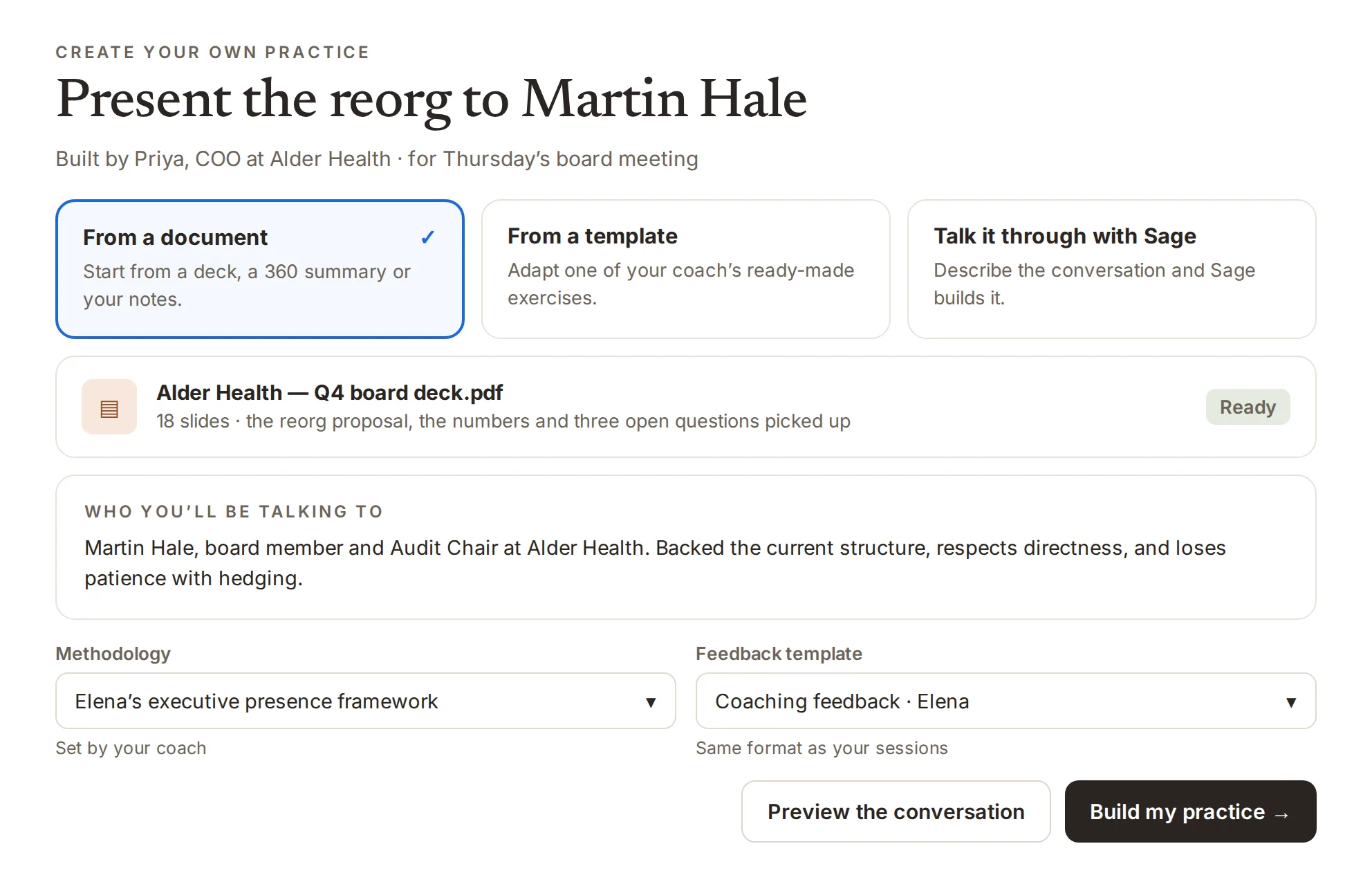
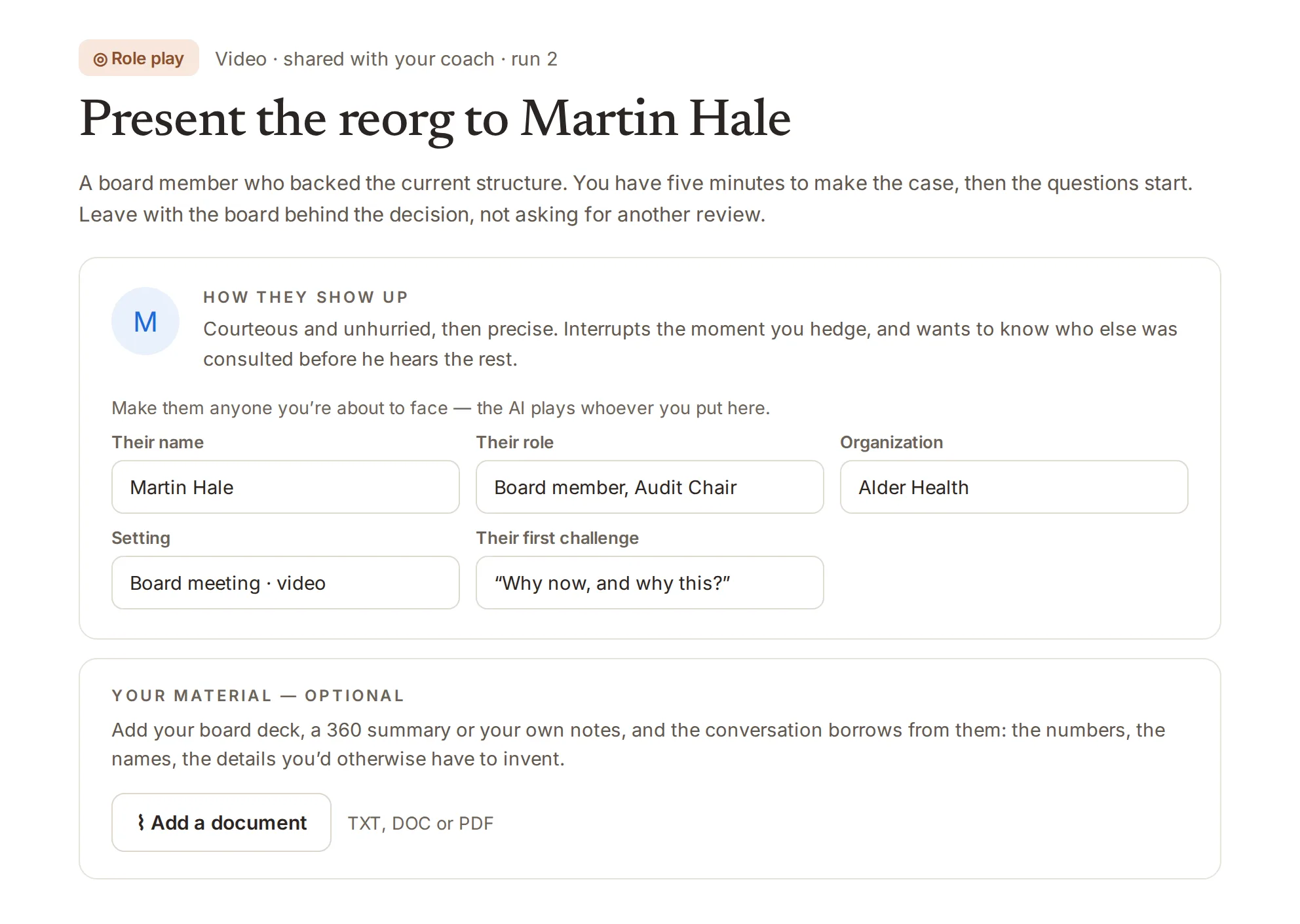
Create your own practice: a COO builds a board-meeting rehearsal from her own board deck, with her coach’s framework and feedback template already assigned
A client builds Thursday’s board meeting from her own deck.

Why I reached out

Sumanta Chakraborty

“After close to thirty years of leading teams, I’ve seen how much rides on conversations nobody rehearses. I’m testing whether practice like this is useful for executive coaches and the leaders they work with. If it isn’t for you, tap . That helps me as much as a booked call.”

Sumanta Chakraborty · Founder & CEO, nSpire AI

Who built it

Built by people who’ve sat in the manager’s chair.

First-time manager, global team lead, VP, C-suite. Between us we’ve lived each step, and built nSpire around the conversations that come with them.

Sumanta Chakraborty

Sumanta Chakraborty

Founder & CEO

Close to three decades building products and leading teams across the US, Europe and Asia, at Siemens, Sony, LG, NVIDIA and Nuance. MBA, UCLA Anderson.

Bani Maiti

Bani Maiti

Co-founder & CTO

About thirty years leading global engineering teams, including as VP of Engineering at FireKing Security Group and in deep learning at Intel. M.Tech in Computer Science, Indian Statistical Institute.

Jennifer Ravalli

Jennifer Ravalli

Fractional Head of Growth

Former CMO of Harri, where she also ran sales, with leadership roles at ADP and iCIMS before that.

We’re also advised by LeeAundra Keany, executive communications coach and UCLA Anderson faculty.

How it works

One

You give it your method.

Your frameworks, models and exercises, plus each client’s context: their role, their stakeholders, the conversations they keep avoiding. We build it with you, and nothing goes live until you’ve signed off. Clients can also build their own from a document, a template or a conversation with Sage.

Setting up a practice conversation: the board member the client will face, how he shows up, and his first challenge.
Two

It becomes the person across the table.

The overdue feedback conversation, delegating real work, coaching an underperformer, pushing back on a senior leader, the conflict between two reports, the Q&A after a change announcement. Voice or video, fifteen minutes, any time between sessions.

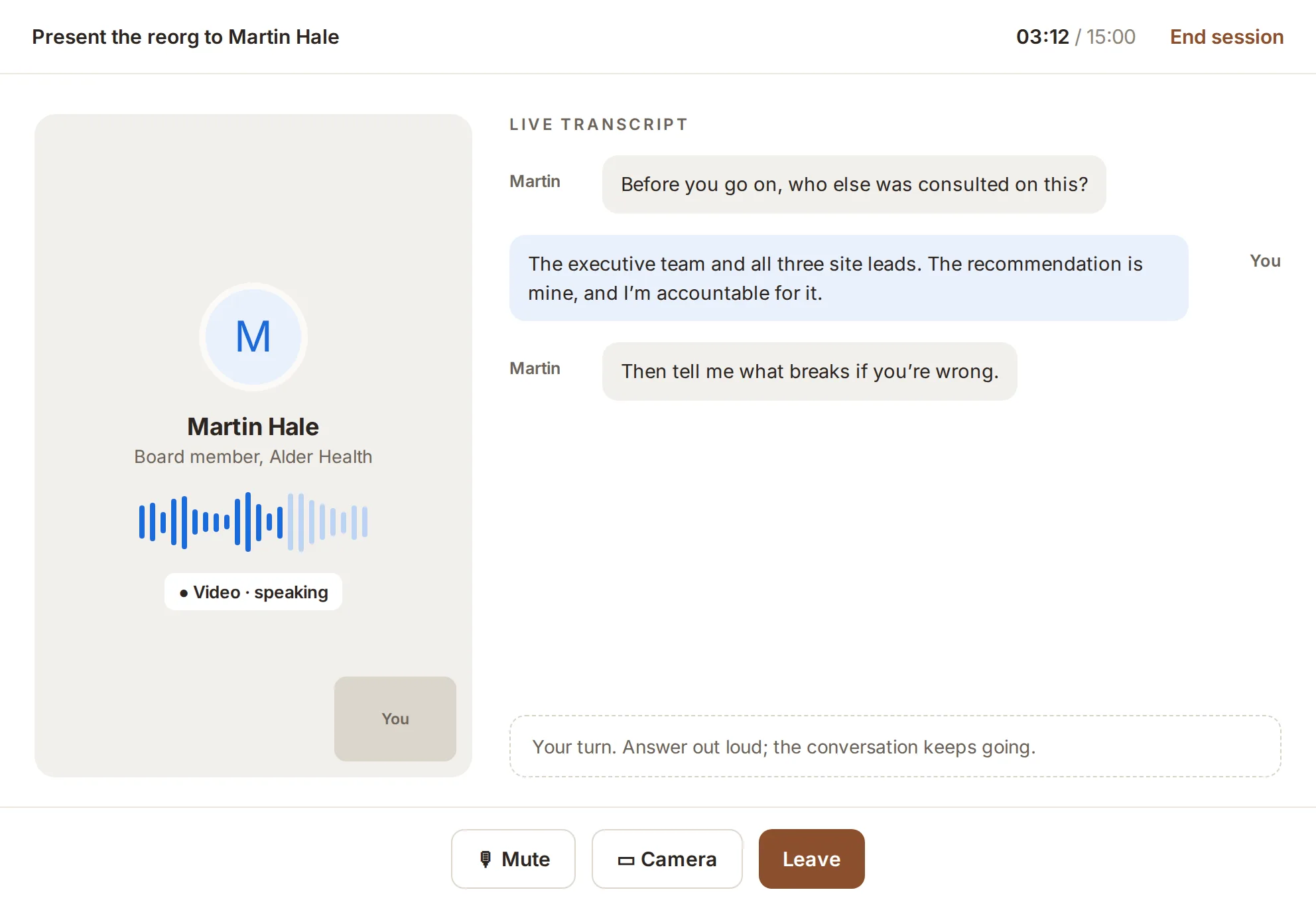
A live video practice session with the AI board member, a live transcript and the session timer.
Three

You see what you’d otherwise miss.

Every session scored on your framework. Who’s practicing, on which conversations, and whether the same habit keeps showing up, without watching a single recording. You walk into the next session knowing where to start.

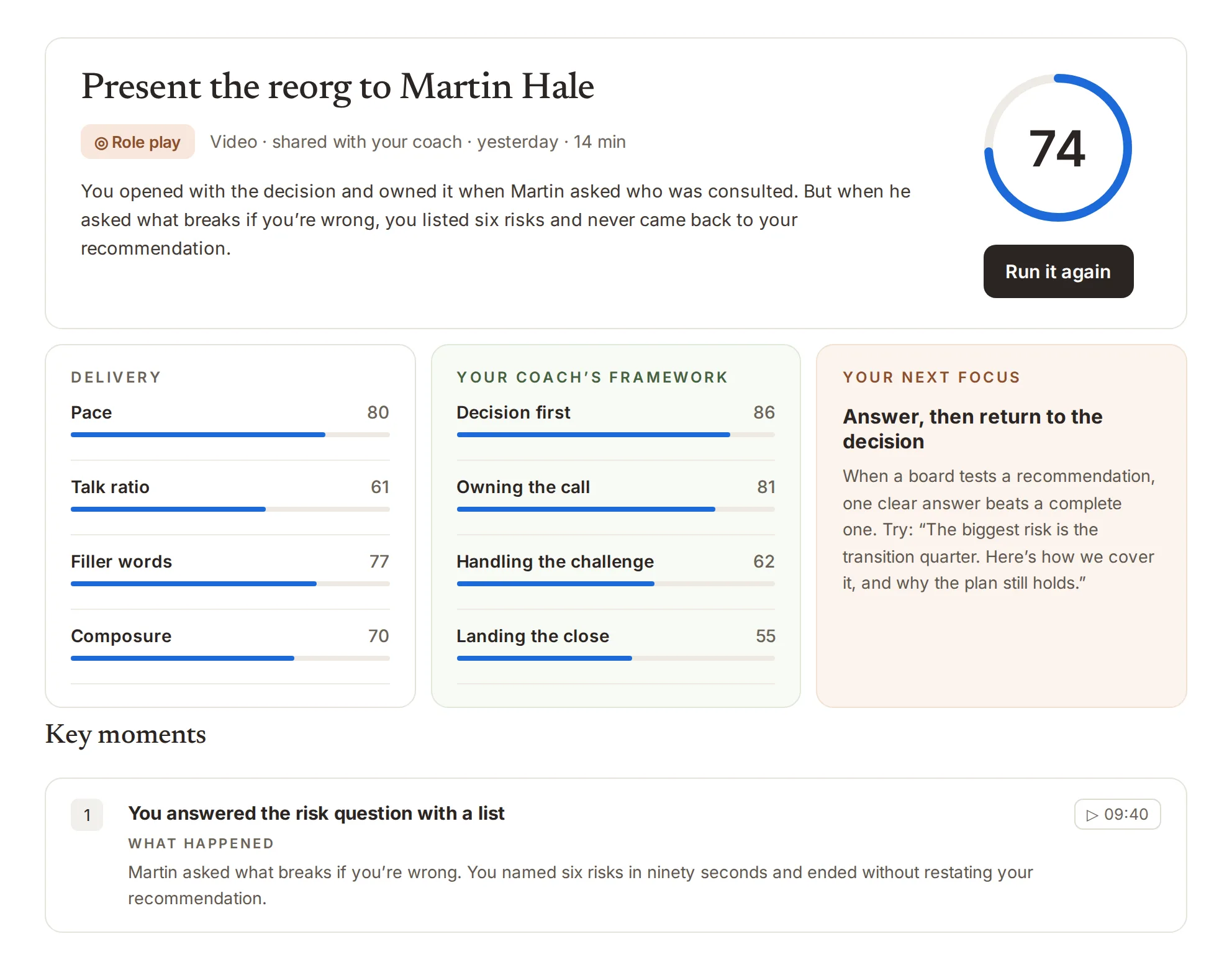
A scored feedback report: overall score, delivery and framework breakdowns, the next focus and a key moment.

Early access

We’re looking for a small group of founding coaching partners.

Executive coaches and coaching firms who want to give clients something between sessions, and help shape it while it’s early.

Your own workspace

Built on your framework, ready for your first client in 72 hours.

Founding pricing

Set with you on the call, built to fold into how you price engagements, and kept as you grow.

A direct line

To the people building it. What you ask for shapes what we build next.

What we ask in return: use it with at least one client, and tell us honestly what works and what doesn’t.

Questions

The ones that come up on the call.

Who owns my method once it’s in nSpire?

You do, entirely. Your material is used only to build your scenarios and feedback. It isn’t shared across accounts, other coaches never see it, and nSpire doesn’t train its AI models on it.

Can it run as a formal assessment?

Yes. The same scenario runs as open practice or as an assigned, graded assessment after a module, with results rolling up for you and, where wanted, the sponsor.

Does this replace my coaching?

No. It’s the practice your clients do between sessions, the part you were never going to be in the room for anyway. You still run the sessions and own the relationship. Sage is your method holding the line in between.

How does it learn my method?

It doesn’t guess at it. We build your scenarios, personas and feedback with you from what you already use: your frameworks, assessments and exercises. You review and approve everything before a client sees it.

Can clients build their own practice?

Yes, three ways. Start from a document, like a board deck or a 360 summary. Adapt one of your exercises. Or describe the conversation to Sage and build it from scratch. They’re practicing within minutes, on your framework.

Can I control how feedback is given?

Yes. Each track and module can carry its own framework and feedback template. If you want every client’s feedback in the same format you use in session, that’s a setting, not a project.

Is it private enough for senior leaders?

Sessions are private by default, so a client can get it wrong without an audience. What rolls up to you is practice and progress, not recordings, and what a sponsor sees is up to you. Your clients’ material, recordings and scores stay theirs and yours, with access limited to the people you grant it to.

Can I use it with a whole leadership team?

Yes. Build a track once and give it to a leadership team or a cohort, with the same framework and feedback for everyone. Each leader can still build practice for their own situation.

Will busy executives actually use it?

Most practice tools get ignored because the practice is generic. Here the client rehearses the conversation they’re actually having this week, which is the reason they come back. Fifteen minutes, whenever it suits them.

How is this different from role-playing with ChatGPT?

ChatGPT will play a board member, but it stays agreeable, doesn’t know your framework, and doesn’t give feedback the way you do. Your clients could do that today without you. This is your method doing the pushing back, which is the difference between a chat and a rehearsal, and the reason it’s yours to offer.

How do I price it into my engagements?

We’re setting pricing with a small group of founding coaching partners now. One option is to fold it into the engagement as a between-sessions layer the client pays for, rather than a software line on your own P&L. We’ll work through the model that fits how you price on the call.

Is it secure?

nSpire is SOC 2 Type II and GDPR compliant, and doesn’t train models on customer data.

How will I know it’s working?

Three signals show up first: who practices without being told, which conversations they keep coming back to, and whether the same habit stops recurring. You’ll see all three within the first two weeks, and they’re what a sponsor wants to hear about too.

Anything else, bring it to the call.

Fair enough. What’s closest?

Reason
When should I check back?